Introduction
If you’re tired of depending on glasses or contact lenses every day, LASIK eye surgery might seem like the perfect solution. It offers the promise of clear vision, convenience, and freedom. But here’s the truth—LASIK is not for everyone.
Before undergoing the procedure, it’s essential to understand whether you are a good candidate for LASIK. Your eye health, lifestyle, age, and medical history all play a crucial role in determining if LASIK is safe and effective for you.
In this blog, we’ll break down the key eligibility factors for LASIK surgery, helping you make an informed decision about your vision correction journey.
What Is LASIK Surgery?
LASIK (Laser-Assisted In Situ Keratomileusis) is a popular refractive surgery that reshapes the cornea using a laser to correct vision problems such as:
- Nearsightedness (myopia)
- Farsightedness (hyperopia)
- Astigmatism
The goal is simple: reduce or eliminate your dependence on glasses or contact lenses.
Why Eligibility Matters
LASIK is a highly advanced and safe procedure, but performing it on unsuitable candidates can lead to:
- Poor visual outcomes
- Dry eyes or discomfort
- Vision fluctuations
- Need for additional treatments
That’s why doctors carefully evaluate each patient before recommending LASIK.
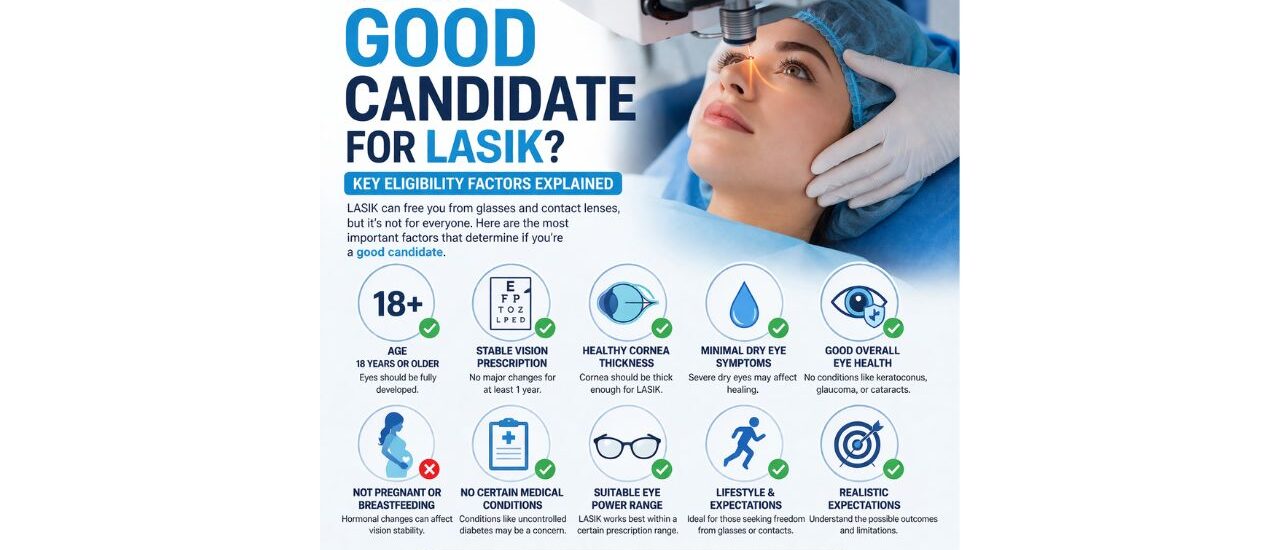
Key Eligibility Factors for LASIK
Let’s explore the most important criteria that determine whether you’re a good candidate:
1. Age Requirement (Minimum 18 Years)
Why it matters:
Your eyes continue to change during your teenage years. Performing LASIK too early can lead to unstable results.
Ideal age group:
- 18 years and above (minimum)
- 21–40 years (most ideal range)
Your prescription should also be stable for at least 1 year before surgery.
2. Stable Vision Prescription
Why it matters:
LASIK permanently reshapes your cornea. If your prescription is still changing, the results may not last.
Eligibility guideline:
- No major change in power for 12 months
- Frequent changes = not ready for LASIK yet
3. Healthy Cornea Thickness
Why it matters:
LASIK involves creating a thin flap in the cornea. If your cornea is too thin, it may not be safe to proceed.
Doctors check:
- Corneal thickness (pachymetry test)
- Corneal shape (topography scan)
Alternative options:
If your cornea is thin, procedures like PRK or SMILE may be recommended instead.
4. No Severe Dry Eye Condition
Why it matters:
LASIK can temporarily worsen dryness. If you already have severe dry eyes, it may lead to discomfort and delayed healing.
Signs of dry eyes:
- Burning sensation
- Redness
- Gritty feeling
Solution:
Mild dryness can often be treated before surgery, making you eligible later.
5. Good Overall Eye Health
Why it matters:
Certain eye conditions can interfere with LASIK results or increase risks.
Not suitable if you have:
- Keratoconus (irregular cornea)
- Cataracts
- Glaucoma (in some cases)
- Eye infections or inflammation
A detailed eye examination is necessary to rule out these conditions.
6. Not Pregnant or Breastfeeding
Why it matters:
Hormonal changes during pregnancy and breastfeeding can temporarily affect your vision and tear production.
Recommendation:
Wait until your hormones stabilize and your vision returns to normal before considering LASIK.
7. No Certain Medical Conditions
Why it matters:
Some systemic diseases can slow healing or increase complications.
Conditions to discuss with your doctor:
- Diabetes (uncontrolled)
- Autoimmune diseases (e.g., lupus, rheumatoid arthritis)
- Immunodeficiency disorders
Controlled conditions may still allow LASIK, depending on your doctor’s evaluation.
8. Suitable Eye Power Range
Why it matters:
LASIK is most effective within a certain range of refractive errors.
Typical treatable range:
- Myopia: up to -8.00 D
- Hyperopia: up to +4.00 D
- Astigmatism: up to ±4.00 D
Higher powers may still be treatable, but require advanced evaluation.
9. Lifestyle and Expectations
Why it matters:
Your daily activities and expectations from LASIK should align with realistic outcomes.
Good candidates usually:
- Want freedom from glasses/contact lenses
- Understand that perfection is not guaranteed
- Are willing to follow post-surgery care instructions
Example:
People in sports, IT professionals, and frequent travelers often benefit greatly from LASIK.
10. Realistic Expectations
Why it matters:
LASIK can significantly improve vision—but it may not always give “perfect” 6/6 vision for everyone.
Important to understand:
- Some patients may still need glasses for night driving or reading
- Results vary based on individual eye conditions
Having realistic expectations leads to higher satisfaction.
Who Should Avoid LASIK?
You may not be a good candidate if you:
- Have very thin corneas
- Experience severe dry eyes
- Have unstable vision
- Are under 18 years old
- Have certain eye diseases
But don’t worry—alternative treatments are available, such as:
- PRK (Photorefractive Keratectomy)
- SMILE surgery
- Implantable lenses (ICL)
Pre-LASIK Evaluation: What to Expect
Before LASIK, your eye doctor will perform a detailed evaluation, including:
- Vision test (refraction)
- Corneal thickness measurement
- Corneal mapping
- Tear film analysis
- Eye pressure test
This process ensures that LASIK is safe and customized for your eyes.
Can You Become Eligible Later?
Yes! If you’re not eligible now, you may become a candidate later by:
- Stabilizing your eye power
- Treating dry eyes
- Managing health conditions
- Waiting until pregnancy/breastfeeding ends
Always consult your eye specialist for personalized guidance.
Benefits of Being the Right Candidate
If you meet all eligibility criteria, LASIK offers:
- Clear vision without glasses
- Quick recovery (often within 24–48 hours)
- Long-lasting results
- Improved lifestyle and confidence
Final Thoughts
LASIK can be life-changing—but only when performed on the right candidate. Understanding the eligibility factors ensures you get the best results with minimal risks.
The key takeaway:
Not everyone qualifies for LASIK, but many people do—with proper evaluation.
If you’re considering LASIK, the best next step is to schedule a comprehensive eye check-up. A qualified eye specialist can assess your eyes and recommend the most suitable vision correction option for you.